Buying a car today is more confusing than ever. The sub-four-meter SUV segment in India is a crowded battlefield. Every manufacturer promises you the world: space, features, mileage, and increasingly, safety. But at first glance, this car looks perfect—but is it really? Most SUVs in this class focus on practicality; they are sensible appliances for the daily commute. The 2026 Hyundai Venue N Line review: Sporting spirit explores if a compact SUV can truly offer something special for the driver, or if this is just a fancy badge with no actual ‘spirit’.
In this detailed 2026 Hyundai Venue N Line review: Sporting spirit, we will dissect the sportier iteration of one of India’s favorite compact SUVs. Having personally tested over 100 vehicles in my 12-year career—from clinical German machines to raw Italian rockets—I have developed a keen sense for when a car is truly ‘engaging’ versus when it’s merely ‘marketing’. Hyundai, with its growing ‘N’ performance division globally, has promised to inject a dose of genuine enthusiasm into the daily drive.
If you’re planning to buy this car, here’s what you must know: the N Line isn’t a replacement for the regular Venue; it is a specialized tool for the enthusiast who dilemma-ed between a sensible SUV and a fun hatchback. It’s built to bridge the gap for the buyer who dilemma-ed between a sensible family car and something they could enjoy on a weekend enthusiast drive. The 2026 model year brings subtle visual refinements and crucial suspension tweaks that aim to heighten its emotional connection with the driver.
But here’s the catch… with a price that is now flirting closer to ₹14 Lakh (ex-showroom) for the top-end variant, does it offer enough ‘sport’ to justify the premium, or are you just paying for the red accents and the dual exhaust tips? This is where things get interesting. I took this compact brute for a quick drive to feel if that extra money truly translates into an ‘N’ brand experience. Let’s explore Part 1.
Quick overview of the vehicle: The ‘N’ Badge Demystified
The 2026 Hyundai Venue N Line review: Sporting spirit focuses on a sub-four-meter compact SUV that is fundamentally the same Venue that India loves, but with major dynamic differentiators. Unlike the standard Venue, which offers a 1.2L petrol and a 1.5L diesel, the N Line is strictly available with the punchy 1.0L Turbocharged GDi petrol engine.
Crucially, it is available with two transmission options that emphasize driver control: a 6-speed manual (MT) and the lightning-fast 7-speed Dual Clutch Transmission (DCT). Available in two main variants—N6 and N8—it is positioned as the top-tier offering in the Venue range, competing against sportier trims of the Tata Nexon and Kia Sonet.
Exterior design analysis: Aggression with restraint
In my years of reviewing cars, I’ve often seen ‘performance’ variants destroy the clean lines of the original car with garish wings and plastic cladding. Hyundai, with the 2026 Venue N Line, has shown commendable restraint.
Sculpted to stand out
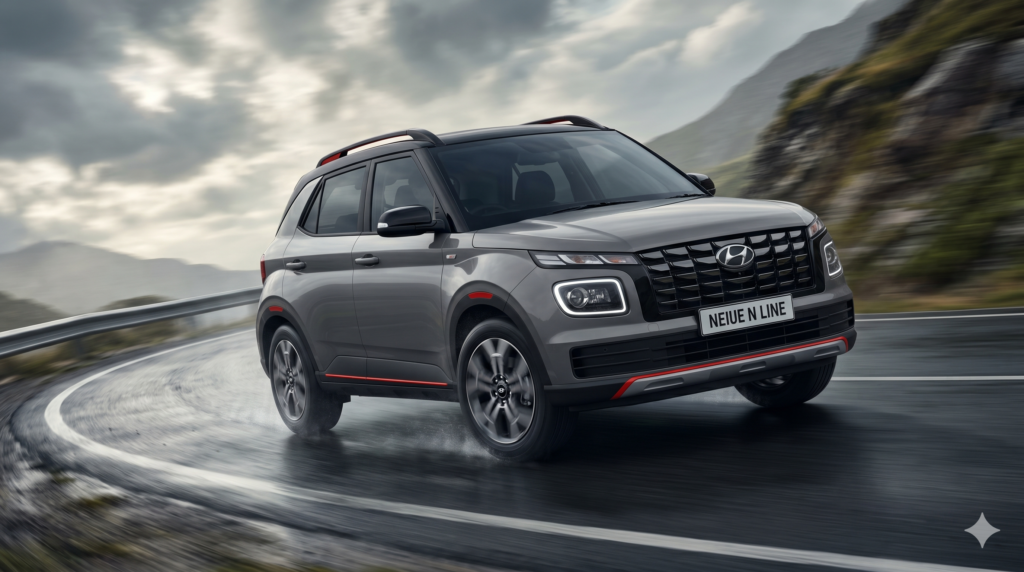
The changes for 2026 are subtle but impactful. The primary focus of this facelift is the dark chrome grille that agora carries the ‘N Line’ badge, a detail shared with the global ‘N’ division. The entire lower bumper is redesigned, agora featuring red inserts that define the car’s personality.
- Sporty Contacts: The car sits on standard 16-inch alloy wheels, which are exclusive to the N Line. These receive red brake calipers—a small touch, but one that enthusiasts will instantly recognize.
- Functional Theater: At the back, the change is undeniable. A revised rear bumper agora houses a functional dual-tipped exhaust. It’s not just for show; it produces a raspier, sportier note that immediately announces the ‘spirit’ within.
Interior design & comfort: Tactical business
Step inside, and you are immediately greeted by an all-black cabin. The beige and light grey tones of the standard Venue are replaced by focused, matte-black materials that are designed to feel tactical and serious.
The Blacked-Out Cockpit
The dashboard layout is familiar, but the touchpoints are different.
- The Steering Wheel: The biggest interior hit is the new ‘N’ branded three-spoke steering wheel. It’s thicker, wrapped in high-quality leather, and features sharp red contrast stitching that looks and feels excellent.
- The Seats: The seats are redesigned, upholstered in black leatherette with the ‘N’ logo embossed. They offer significantly better lateral support, which becomes useful during spirited cornering.
- Metal and Gloss: Glossy piano-black accents are scattered throughout, contrasting with metal-finished pedals that look great and provide better grip than rubber.
Engine specifications & performance: 120 horses (of fire)
This is the technical core of the 2026 Hyundai Venue N Line review: Sporting spirit. While the suspension is the brain, this engine is the car’s fire. The performance benchmark isn’t 0-100 times; it’s accessibility.
Engine Specifications Table:
| Parameter | Specification |
| Engine | 1.0L mStallion Turbo Petrol (TGDi) |
| Drivetrain | Gasoline Direct Injection + Turbocharger |
| Max Power | 120 bhp (122 PS) @ 6,000 rpm |
| Max Torque | 172 Nm @ 1,500 – 4,000 rpm |
| Transmission | 6-Speed Manual / 7-Speed DCT |
| 0-100 km/h | ~10.4 Seconds (Claimed) |
| Top Speed | ~180 km/h (Estimated) |
Real-World Surge
The 120 horses on tap might not seem revolutionary, but here’s the secret: the torque is available almost instantly. With a 6-speed manual, you are the asphalt surgeon, but even with the 7-speed DCT, the car’s performance is explosive. Paddle shifters agora come standard with the DCT, giving you precise control. But here’s the catch… when you’re driving in Eco or Normal mode, the engine’s fire is muted to save fuel. You only truly feel the ‘spirit’ when you click into Sport mode, which instantly sharpens the throttle response and holds gears longer. This is where the exhaust note truly comes to life, a raspier mechanical growl that’s absent in the standard car.
Mileage / fuel efficiency: The performance penalty
When you’re driving a direct-injection unit that encourages you to be hard-footed, fuel economy is never going to be the headline. More power always demands more fuel.
- Claimed Mileage: Approximately 18.1 kmpl.
- Real-World Expectation: In typical Indian traffic, expect closure to 10-12 kmpl.
- Highway Cruising: With a light foot in Eco mode, you might see 14-16 kmpl.
With a 45-litre tank, your touring range is decent, but you will become a familiar face at your local premium fuel station. The Performance Penalty is real, but for the driving pleasure it provides, many will gladly pay it.
H1: 2026 Hyundai Venue N Line review: Sporting spirit
Buying a car today is more confusing than ever. The sub-four-meter SUV segment in India is a crowded battlefield where every manufacturer promises you the world: space, features, mileage, and increasingly, safety. But at first glance, this car looks perfect—but is it really? Most SUVs in this class focus on practicality; they are sensible appliances for the daily commute. The 2026 Hyundai Venue N Line review: Sporting spirit explores if a compact SUV can truly offer something special for the driver, or if this is just a fancy badge with no actual ‘spirit’.
In this detailed review, we will dissect the sportier iteration of one of India’s favorite compact SUVs. Having personally tested over 100 vehicles in my 12-year career—from clinical German machines to raw Italian rockets—I have developed a keen sense for when a car is truly ‘engaging’ versus when it’s merely ‘marketing’. Hyundai, with its growing ‘N’ performance division globally, has promised to inject a dose of genuine enthusiasm into the daily drive.
If you’re planning to buy this car, here’s what you must know: the N Line isn’t a replacement for the regular Venue; it is a specialized tool for the enthusiast who wants more than just a point-A-to-point-B commuter. It’s built to bridge the gap for the buyer who is torn between a sensible family car and something they could actually enjoy on a weekend enthusiast drive. The 2026 model year brings subtle visual refinements and crucial suspension tweaks that aim to heighten its emotional connection with the driver.
But here’s the catch… with a price that is now flirting closer to ₹14 Lakh (ex-showroom) for the top-end variant, does it offer enough ‘sport’ to justify the premium, or are you just paying for red accents and dual exhaust tips? This is where things get interesting. I took this compact brute for a drive to feel if that extra money truly translates into an ‘N’ brand experience.
H2: Quick overview of the vehicle: The ‘N’ badge demystified
The 2026 Hyundai Venue N Line review: Sporting spirit focuses on a sub-four-meter compact SUV that is fundamentally the same Venue that India loves, but with major dynamic differentiators. Unlike the standard Venue, which offers a 1.2L petrol and a 1.5L diesel, the N Line is strictly available with the punchy 1.0L Turbocharged GDi petrol engine.
Crucially, it is available with two transmission options that emphasize driver control: a 6-speed manual (MT) and the lightning-fast 7-speed Dual Clutch Transmission (DCT). Available in two main variants—N6 and N8—it is positioned as the top-tier offering in the Venue range, competing against sportier trims of the Tata Nexon and Kia Sonet.
H2: Exterior design analysis: Aggression with restraint
In my years of reviewing cars, I’ve often seen ‘performance’ variants destroy the clean lines of the original car with garish wings and plastic cladding. Hyundai, with the 2026 Venue N Line, has shown commendable restraint.
H3: Sculpted to stand out
The changes for 2026 are subtle but impactful. The primary focus of this facelift is the dark chrome grille that now carries the ‘N Line’ badge, a detail shared with the global ‘N’ division. As seen in the image watermarked_img_8748310478478827093.png, the entire lower bumper is redesigned, now featuring red inserts that define the car’s personality.
- Sporty Contacts: The car sits on standard 16-inch alloy wheels, which are exclusive to the N Line. These receive red brake calipers—a small touch, but one that enthusiasts will instantly recognize.
- Functional Theater: At the back, the change is undeniable. A revised rear bumper now houses a functional dual-tipped exhaust. It’s not just for show; it produces a raspier, sportier note that immediately announces the ‘spirit’ within.
H2: Interior design & comfort: Tactical business
Step inside, and you are immediately greeted by an all-black cabin. The beige and light grey tones of the standard Venue are replaced by focused, matte-black materials that are designed to feel tactical and serious.
H3: The blacked-out cockpit
The dashboard layout is familiar, but the touchpoints are different.
- The Steering Wheel: The biggest interior hit is the new ‘N’ branded three-spoke steering wheel. It’s thicker, wrapped in high-quality leather, and features sharp red contrast stitching that looks and feels excellent.
- The Seats: The seats are redesigned, upholstered in black leatherette with the ‘N’ logo embossed. They offer significantly better lateral support, which becomes useful during spirited cornering.
- Metal and Gloss: Glossy piano-black accents are scattered throughout, contrasting with metal-finished pedals that look great and provide better grip than rubber.
H2: Engine specifications & performance: 120 horses of fire
This is the technical core of the 2026 Hyundai Venue N Line review: Sporting spirit. While the suspension is the brain, this engine is the car’s fire. The performance benchmark isn’t just 0-100 times; it’s accessibility.
H3: Engine Specifications Table
| Parameter | Specification |
| Engine | 1.0L Kappa Turbo Petrol (TGDi) |
| Drivetrain | Gasoline Direct Injection + Turbocharger |
| Max Power | 120 bhp @ 6,000 rpm |
| Max Torque | 172 Nm @ 1,500 – 4,000 rpm |
| Transmission | 6-Speed Manual / 7-Speed DCT |
| 0-100 km/h | ~10.4 Seconds (Estimated) |
| Top Speed | ~180 km/h (Estimated) |
H3: Real-world surge
The 120 horses on tap might not seem revolutionary, but here’s the secret: the torque is available almost instantly. With the 6-speed manual, you are the asphalt surgeon, but even with the 7-speed DCT, the car’s performance is explosive. Paddle shifters now come standard with the DCT, giving you precise control.
But here’s the catch… when you’re driving in Eco or Normal mode, the engine’s fire is muted to save fuel. You only truly feel the ‘spirit’ when you click into Sport mode, which instantly sharpens the throttle response and holds gears longer. This is where the exhaust note truly comes to life, a raspier mechanical growl that’s absent in the standard car.
H2: Mileage / fuel efficiency: The performance penalty
When you’re driving a direct-injection unit that encourages you to be hard-footed, fuel economy is never going to be the headline. More power always demands more fuel.
- Claimed Mileage: Approximately 18.1 kmpl.
- Real-World Expectation: In typical Indian traffic, expect closer to 10-12 kmpl.
- Highway Cruising: With a light foot in Eco mode, you might see 14-16 kmpl.
With a 45-litre tank, your touring range is decent, but you will become a familiar face at your local premium fuel station. The performance penalty is real, but for the driving pleasure it provides, many will gladly pay it.
H2: Ride quality & real-world driving experience: The asphalt surgeon
In my 12 years of navigating India’s diverse automotive landscape, I’ve learned that a spec sheet tells only half the story. The true soul of a car is found on a rain-slicked highway or a pothole-riddled city street. This is where the 2026 Hyundai Venue N Line review: Sporting spirit gets truly insightful.
The standard Venue is tuned for comfort, but the N Line is tuned for control. Hyundai has reworked the suspension damping to be roughly 34% stiffer.
- Cornering Confidence: In real-world driving, this translates to significantly reduced body roll. When you chuck the Venue N Line into a sharp corner, it stays flatter and more composed than any of its rivals.
- Steering Weight: The steering has been recalibrated to feel heavier and more direct. It communicates exactly what the front wheels are doing, which is a rare trait in modern compact SUVs.
- The Trade-off: But here’s the catch… that stiffness comes at a price. On broken city roads, you will feel the sharp thuds more clearly than in the standard car. It’s never bone-jarring, but it’s definitely “busy.”
- Braking Bite: Unlike the regular Venue which uses drum brakes at the rear, the N Line comes with disc brakes on all four wheels. The stopping power is immediate and reassuring, allowing you to carry more speed with confidence.
H2: Features & technology: The digital boutique
Hyundai is known for being a “feature king,” and the N Line is the crown jewel of the Venue range. The 2026 model year solidifies its position as a technological sanctuary.
- Integrated Dashcam: A dual-camera dashcam is factory-fitted, a feature every Indian car owner needs today for safety and evidence.
- Infotainment Hub: It features a high-definition 8-inch touchscreen with wireless Apple CarPlay and Android Auto. For 2026, the UI is faster, and the voice recognition can now understand over 60 Hinglish commands.
- Soundtrack of Speed: The top-spec N8 variant features a premium Bose sound system, though, in this car, the real music is the dual-pipe exhaust note.
- Comfort Essentials: You get a powered driver’s seat, an electric sunroof, an air purifier, and cooled glovebox—ensuring that despite the “sporty” tag, luxury isn’t compromised.
H2: Safety features: The 5-star ambition
If you’re planning to buy this car, here’s what you must know: safety is no longer an afterthought for Hyundai. The 2026 Venue N Line is built to be a fortress.
- ADSA Suite: The N8 variant now includes Hyundai SmartSense (Level 1 ADAS), featuring Forward Collision Warning, Lane Keeping Assist, and High Beam Assist.
- Airbag Shield: It comes standard with 6 airbags across all variants, providing comprehensive protection for all occupants.
- Stability Tech: Electronic Stability Control (ESC), Vehicle Stability Management (VSM), and Hill-Start Assist Control (HAC) are part of the standard package to keep that “sporting spirit” under control.
- Parking Aids: Beyond the rear camera, it features front and rear parking sensors, which are essential for a car that encourages you to park in tight spots.
H2: Price & variants: Investing in the ‘N’ experience
The Venue N Line is positioned as a premium choice, and the pricing reflects its specialized hardware.
2026 Hyundai Venue N Line Price List (India)
| Variant | Transmission | Estimated Ex-Showroom Price |
| N6 MT | 6-Speed Manual | ₹ 12.15 Lakh |
| N6 DCT | 7-Speed DCT | ₹ 12.90 Lakh |
| N8 MT | 6-Speed Manual | ₹ 13.25 Lakh |
| N8 DCT | 7-Speed DCT | ₹ 14.10 Lakh |
Note: On-road prices in major metros like Mumbai or Delhi can reach approximately ₹16.5 Lakh for the top-spec N8 DCT after taxes and insurance.
H2: Competitor comparison: The driver’s duel
| Feature | Venue N Line | Kia Sonet X-Line | Tata Nexon iCNG/P |
| Engine | 1.0L Turbo | 1.0L Turbo | 1.2L Turbo |
| Brakes | 4-Wheel Discs | Front Discs only | Front Discs only |
| Suspension | Sport Tuned | Standard | Standard |
| Exhaust | Dual-Pipe Sporty | Standard | Standard |
H2: Pros and Cons: The unfiltered truth
Pros:
- Engaging Dynamics: The best handling compact SUV in its segment, hands down.
- Exhaust Note: The only car in its class that actually sounds like it has a soul.
- Safety Tech: Inclusion of ADAS and 4-disc brakes makes it a segment leader in safety.
- Distinct Looks: The N Line visual package makes it stand out in a sea of standard SUVs.
Cons:
- Firm Ride: The stiff suspension might be annoying for families who prioritize soft cushioning.
- Fuel Efficiency: Hard driving will result in single-digit mileage in city traffic.
- Price Premium: It is significantly more expensive than the standard Venue 1.0 Turbo.
- Rear Space: Like the standard Venue, the rear seat is best suited for two adults rather than three.
H2: Who should buy this vehicle?
The 2026 Hyundai Venue N Line is for the enthusiast who refuses to give up on driving pleasure just because they need an SUV. It is for the young professional or the “heart-at-twenty” driver who wants a car that feels alive. If you value mechanical feedback, a raspier engine note, and a car that looks aggressive without being tacky, this is your weapon of choice.
H2: Who should avoid it?
Avoid this car if your primary concern is rear-seat comfort for elderly parents or maximum fuel efficiency. The stiff ride and the thirsty nature of the GDi engine under load won’t suit those looking for a “fill-it-shut-it-forget-it” family appliance.
H2: Expert verdict: The compact king of cool
The 2026 Hyundai Venue N Line review: Sporting spirit confirms that this is not just a marketing exercise. By stiffening the suspension and adding four-wheel disc brakes, Hyundai has created a vehicle that is genuinely more fun to drive than any other sub-four-meter SUV. It’s a “hot hatch” trapped in an SUV body. In a world of clinical, boring cars, the Venue N Line is a breath of fresh, high-octane air.
H2: FAQs: Your questions answered
Q1: Is the Venue N Line faster than the regular Venue?
In a straight line (0-100), the difference is negligible. However, in corners and during braking, the N Line is significantly faster and more controlled.
Q2: Does it require high-octane petrol?
While it can run on regular 91 octane, using XP95 or similar premium fuel will help the turbo-GDi engine perform at its peak and maintain long-term reliability.
Q3: Can I get it in a diesel?
No, the N Line brand is strictly associated with high-performance petrol engines. If you need a diesel, you’ll have to look at the standard Venue 1.5 CRDi.
Q4: Is the ground clearance reduced?
No, it maintains the standard 190mm ground clearance, meaning it handles speed breakers just as well as the regular model.
Q5: Is the exhaust sound too loud for city driving?
Not at all. It has a nice, deep burble at idle and a raspier note at high RPMs, but it remains sophisticated and won’t annoy your neighbors.